
British Family Mediation
Professional Family Mediation Services
Family Mediation Services · United Kingdom
Family change is rarely simple. When people are trying to figure out separation, parenting arrangements, practical decisions or tough conversations about the future — structured mediation provides a human, impartial and clearly guided way forward for every family.

Family change can all become overwhelming very quickly. It can mean worry about children, worry about fairness, stress about money or just the feeling that everything has become too fraught to manage alone. Most people are not looking for conflict during those times. They are seeking clarity, stability, and a process that can smooth the way for all to move forward.
At the heart of what we offer is a supportive structure in which to have a conversation. The British Family mediation service provides a place for people to talk things through, discuss what matters most and consider tangible solutions that work given their own family situation. Our services are designed to assist that process in a way that feels measured, respectful and focused on the people involved — not on winning or losing.
For many families, this kind of support is important because family matters are not simply legal matters. They are personal. They have an impact on everyday life, routines, parenting, housing, finances and peace of mind. A process that respects those realities, such as the one offered by British Family mediation service Bedfordshire, can make a real difference. Our approach strives to embody that understanding with a service that feels considered, down-to-earth and clear.

The Mediation Information and Assessment Meeting — commonly referred to as the MIAM — is typically the first formal step in the mediation process. It is an individual meeting between a person and a qualified mediator, held before any joint sessions take place. It is not a commitment to proceed further. It is, quite simply, an opportunity to find out more.
During a MIAM, the mediator will explain how mediation works, discuss the background to the situation and assess whether mediation is likely to be a suitable and helpful option given the circumstances. The meeting is confidential, and each party typically attends their own individual session rather than meeting together at this early stage. That arrangement allows each person to speak freely, without the pressure of the other party being present.
The MIAM is also the stage at which legal aid eligibility may first be considered. If a person believes they may qualify for legal aid, the MIAM provides the appropriate moment to raise that question and receive information about what it might mean in practice. Understanding eligibility early on can help people make clearer decisions about how they wish to proceed.
Each party attends separately at this stage, allowing open and honest conversation without pressure or the presence of the other party.
The MIAM is purely informational. Attending does not commit anyone to joint sessions or further mediation involvement of any kind.
Legal aid eligibility can be considered at this stage, meaning people understand their financial options before making any decisions about proceeding.
The mediator will honestly assess whether mediation is appropriate for the specific circumstances and will explain the findings to the individual clearly.

When a relationship ends, the conversations that follow can feel almost impossible to have. There is often a great deal of emotion involved — grief, frustration, uncertainty and sometimes anger. Divorce mediation provides a structure for those conversations that makes them more manageable. It is not a substitute for legal proceedings, but it is often a far more constructive starting point.
Divorce mediation is designed to assist separating couples in working through the practical and personal matters that arise when a relationship ends. These may include where children will live, how time will be divided between homes, how communication between parents will work in the longer term and how the day-to-day logistics of shared parenting can be made to function smoothly. It may also address matters related to the family home and other shared assets, where the circumstances make this appropriate.
One of the things that makes divorce mediation particularly valuable is its pace. Unlike more formal processes, mediation allows people to take the time they need. There is no rush to resolve everything in one sitting. Issues can be addressed gradually, in an order that makes sense to the people involved. That slower, more deliberate pace is often exactly what people need at a time when everything can feel very raw.
For many separating couples, the goal of divorce mediation is not to eliminate every disagreement — that would be an unrealistic expectation. The goal is to create a more structured and respectful environment for addressing the things that need to be addressed, so that both parties can move forward with a greater degree of clarity and less unnecessary conflict. British Family Mediation Services approaches this work with that realistic and human ambition in mind.
Discussions about where children will live, how time is divided and how transitions between homes can be managed as smoothly as possible.
Establishing clearer patterns for how parents will communicate after separation, reducing misunderstanding and unnecessary friction over time.
Working through school schedules, holiday arrangements, birthday plans and the many other practical details that shape a child's daily life and sense of continuity.
Mediation moves at a speed that respects the complexity of what is being discussed, rather than rushing people towards conclusions they are not ready for.

Financial concerns are among the most common and most difficult aspects of family separation. When household income is affected, living arrangements change and the future feels uncertain, conversations about money can easily become charged and unproductive. Financial mediation offers a more considered way of addressing those conversations — one that keeps the focus on practical outcomes rather than blame or grievance.
Financial mediation is concerned with helping people discuss and work towards practical arrangements relating to the financial aspects of family separation. This may involve matters related to the family home, shared assets, income, outgoings and the longer-term financial wellbeing of both parties and any children involved. The process is structured but flexible, allowing discussions to develop in a way that is proportionate to the complexity of the circumstances.
When funds are already low, the cost of resolving financial disputes through more formal channels can feel like an additional and significant barrier. Financial mediation — particularly where legal aid is available — can help ensure that cost does not become the deciding factor in whether people can access a constructive resolution process. British Family Mediation Services treats this accessibility as a matter of genuine importance, and the service is designed with that principle firmly in mind.
Financial mediation does not replace independent legal advice, and it is always recommended that people seek their own professional guidance on any agreements reached. What it does offer is a structured and supported environment in which to have those difficult conversations — and to arrive at a clearer and more considered position before engaging with other formal processes.
A structured space to discuss the family home, shared assets and how financial responsibilities may be divided or reorganised following separation.
Conversations about ongoing financial arrangements, including how income and expenses may be managed across two households rather than one.
Ensuring that discussions about finances keep the needs of children clearly in view, addressing the practical costs of raising children across two homes.
For those who may qualify, legal aid can make financial mediation accessible regardless of financial pressures — a practical and meaningful form of support.

Legal aid mediation refers to family mediation that may be paid for in part or in full by legal aid, subject to eligibility. It is designed to ensure that those people who might not otherwise be able to afford family mediation are not prevented from accessing a process that could make a genuine and meaningful difference to their situation. The gist is straightforward: if someone qualifies for legal aid, it can help clear or reduce a financial barrier to mediation.
Legal aid mediation is particularly relevant in family situations because disputes tend to arise at exactly the moment when people are already feeling the pressure most acutely. Separation can impact household income, living arrangements and daily stability. When funds are limited, the cost of fixing problems can add another layer of stress to an already difficult situation. Legal aid mediation is there to make the process more accessible for those who find themselves in that position.
It should be emphasised clearly that legal aid mediation is not a lesser process. It is, nonetheless, a thorough and methodical procedure for resolving family disputes through structured dialogue. The difference is simply that it can be supported financially in a way that makes access easier for those who need it. The focus remains firmly on dignity, fairness and practical support throughout.
And for many people, legal aid is not just a matter of finances — it also matters emotionally. When support feels out of reach, people may postpone seeking help, avoid hard conversations or remain in arrangements that no longer work. Legal aid can help lower that barrier and make it possible for the process to start at the right time, rather than after further unnecessary delay.
It is important to note that legal aid does not denote unimportant issues. It simply means that, if you meet certain criteria, access to mediation should be easier. British Family Mediation Services treats that access as something significant, because a fair process should not be unattainable simply because someone is under financial strain.
Eligibility is determined by your individual financial circumstances and the nature of the matter being addressed. It is always worth checking carefully rather than assuming you do or do not qualify.
Receiving support through legal aid does not change the quality, structure or impartiality of the mediation. The process remains the same in every meaningful respect.
Where it applies, legal aid can mean that the cost of mediation is not the deciding factor in whether a family can access the support they need to move forward.
Many people assume they will not qualify and never enquire further. Someone who believes they are ineligible may be surprised to find that they do in fact meet the relevant criteria.
The purpose is to explain what legal aid covers, what it means in practice and how it may interact with the mediation process — clearly, without unnecessary jargon or complexity.
Family mediation provides a mechanism for people to try and work through challenging issues without engaging in a formal, adversarial process. That matters, because when a dispute becomes too legalistic or too mired in emotion, it becomes more difficult to reach tangible outcomes. Mediation offers a different pace — one reflected in British Family mediation service Berkshire — and creates a space where people can pause, listen and consider before decisions are made.
For many families, that slower pace is a precious commodity. It can help alleviate feelings of being rushed into arguments or forced into positions before they are ready. It can facilitate conversations about children's needs, what seems realistic and what living arrangements might truly work day-to-day. It can also help people concentrate on what comes next rather than dwelling solely on what has not worked.
Mediation is not about sides or winning. It is about creating the conditions for a genuinely productive conversation. Many families find that this shift in tone — from confrontation to cooperation — makes an immediate and tangible difference to how discussions feel and how they progress. This type of process is supported by British Family Mediation Services because family matters typically require more than just a definitive yes or no answer.
Children tend to do better when adults can make calmer, clearer choices about their routines and care. Mediation gives parents a structured way to keep their attention on what matters most: what is best for the children, rather than what divides the adults. That does not mean that everything becomes easy. It means the process is far more likely to remain constructive and focused on the right things. Family mediation can also be beneficial to those who simply wish to avoid unnecessary escalation.
Formal processes can feel unfamiliar, impersonal and emotionally taxing. Mediation carries a different tone and structure — it feels more personal, more flexible and more oriented towards practical, workable agreement. It can be formal in the sense of being well-structured and professionally guided, while still feeling human and appropriate to the real lives of the people involved. British Family Mediation Services embodies that approach by maintaining a simple and approachable process throughout.
When things stay unsettled for a long time, the uncertainty can itself become exhausting. Mediation can assist in making progress more orderly and more efficient than open-ended disagreement. Even if the process is gradual, it is often considerably preferable to aimlessly prolonged conflict. Many families appreciate that mediation can help them move forward more purposefully, without sacrificing the care and deliberateness that complex family matters genuinely deserve.
Families also appreciate mediation because it can protect a more functional relationship after separation. Not every relationship will warm again, and that is not the goal. The ambition is often more modest and more crucial: to simplify communication enough that the work of practical parenting and day-to-day life can proceed without constant friction. That kind of realistic, respectful outcome is at the heart of what British Family Mediation Services aims to support for every family it works with.
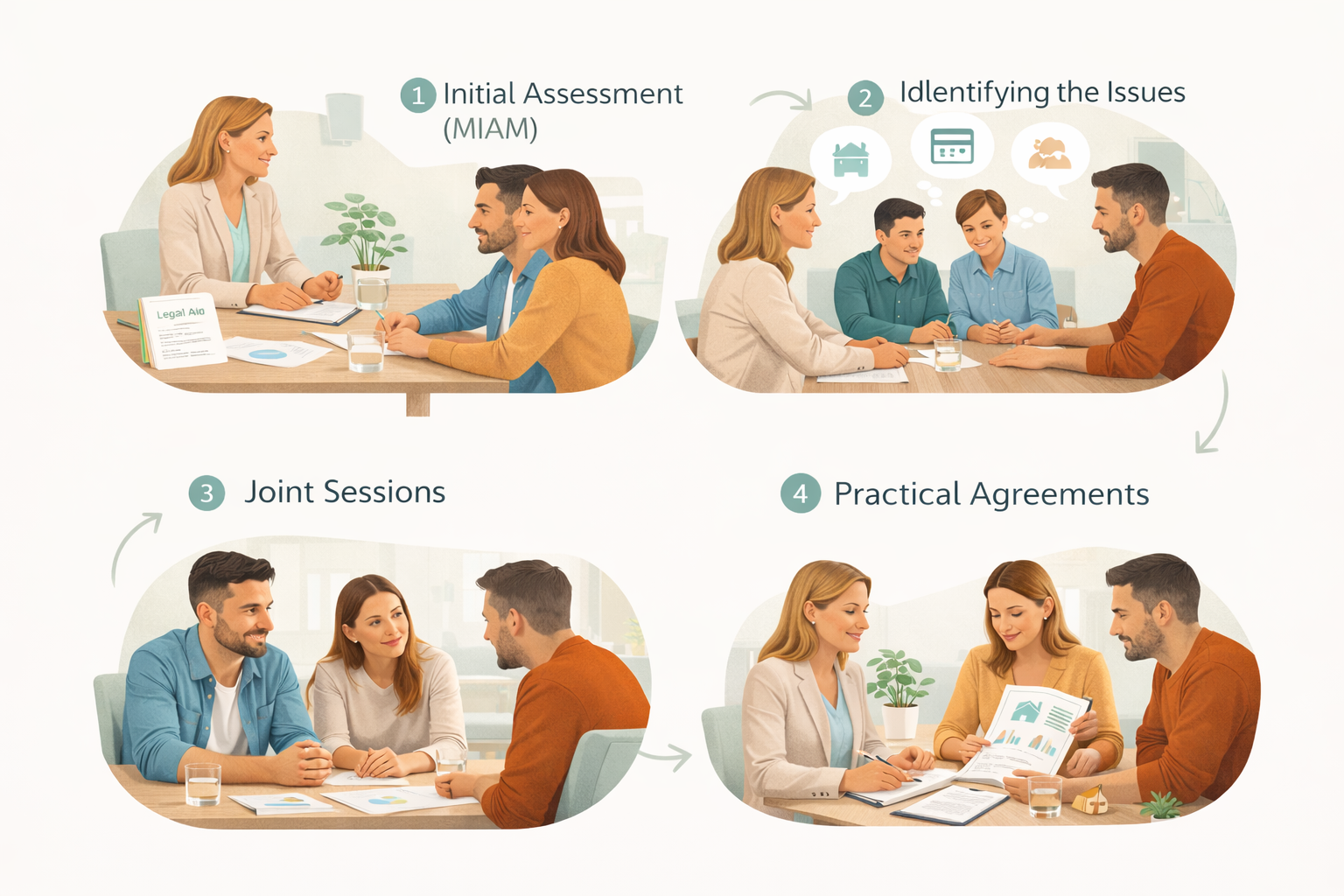
Most mediators will begin with an initial stage that involves identifying the key issues and explaining the process to those involved. At this point, people begin to understand what mediation can and cannot accomplish. It is also where the main concerns are typically presented to keep subsequent discussions on track. The process is structured but human — not something to fear.
Each party meets individually with the mediator to discuss the situation, explore suitability and understand what the process involves — without any obligation to proceed.
The key matters to be addressed are established clearly. This ensures that subsequent sessions have a clear focus and that the most important concerns are not overlooked or avoided.
Mediation is typically a joint process in which the parties communicate about their disputes with professional guidance. Sessions are managed carefully to keep the discussion constructive and focused on moving forward.
The process moves towards practical agreement, working through details piece by piece rather than attempting to resolve everything at once. Agreements reached can be referred to legal advisers for formalisation if required.
Mediation most commonly is a joint process in which the parties communicate about their disputes with assistance. At times the discussion will need to be managed carefully, step by step, particularly if feelings are running high or there has been a significant breakdown of communication. The idea throughout is to keep the process constructive — and to move forward in a way that feels safe and manageable for everyone involved.
There may also be differences of view which need to be handled individually before discussion together. That can enable each side to articulate its concerns more fully, and it can make it easier to identify where progress might be achievable. British Family Mediation Services understands when people need more time, more structure or a gentler pace — and the process is adapted accordingly.
If legal aid is applicable, that aspect of the process will also be addressed. Everyone should understand how legal aid interacts with mediation and whether it might cover part or all of the cost. The aim is to help individuals understand that aspect of the procedure clearly and without it feeling overwhelming or confusing.
Mediation might bring some clarity relatively quickly in certain circumstances. In others, it may take longer. That does not mean it has not been successful. It means that the issues are serious and worthy of care. A deliberate process is considerably more likely to result in agreements that people can genuinely live with over the long term.
Family mediation services can assist people involved in a wide range of family situations. It can be very helpful for separating couples who must determine child arrangements, communication styles and much more. It can also assist parents who are not together but require a better way to talk about parenting decisions. And sometimes it may be relevant to broader family situations where tension has developed and a more respectful process for addressing it is needed.
Those going through separation or divorce who need a structured, guided way to address children's arrangements, communication and the practical matters that follow the end of a relationship.
Parents who are no longer together but need a better, more workable way to communicate about parenting decisions, childcare arrangements and the ongoing responsibilities that come with raising children across two homes.
Situations where tension has built over time — where repeated miscommunication and accumulated stress have made ordinary conversations feel almost impossible — and where a more respectful structure for dialogue is genuinely needed.
People who are not yet sure whether mediation is the right option for them — who have questions, doubts or concerns about the process — and who would benefit from a clear, honest and non-pressured explanation of what it involves.
People who may be eligible for legal aid and who need clear, accessible information about what that means in practice — without being overwhelmed by complex eligibility criteria or technical language that is hard to navigate alone.
Those who are not yet in deep conflict but who can see it developing — and who want to address family matters constructively at an early stage, before communication breaks down further and the issues become more entrenched.
When a family is under pressure, people need more than information. They need to feel reassured that the process is manageable. They want clear explanations, not legal language that sounds stuffy or removed from the realities of their situation. They want to understand what each stage is for and how they can expect the following stages to look. They may find it difficult to move from emotion to constructive conversation without feeling shut down or rushed through something they are not yet ready for.
British Family Mediation Services is built with that need in mind. It understands that individuals may arrive in mediation carrying sadness, anger, frustration, uncertainty or simple weariness. Those feelings do not disappear because a conversation has a structure. But a careful and well-managed process can make those moments more manageable — and can create the conditions for genuine progress.
No. In most cases, each person first attends an individual meeting with the mediator before any joint sessions take place. This allows both parties to speak freely, raise concerns and understand the process before sitting in the same room. Joint sessions only proceed when the mediator is satisfied that they are likely to be constructive and appropriate for the circumstances.
A properly managed mediation process is designed to ensure that both people are able to speak and to be genuinely heard. Differences in confidence or communication style are a normal part of the process. The mediator's role includes being attentive to that dynamic and making sure that neither party is inadvertently silenced or dominated by the other. Fairness of process is fundamental to mediation, not an optional extra.
Absolutely not. Mediation is generally a gradual process, and the expectation that everything will be resolved in a single conversation is neither realistic nor helpful. Some matters are simpler to address; others require more time, more care and more preparation. Progress is often incremental, and that is not a sign of failure — it is a sign that the process is being conducted with appropriate thoughtfulness. The number of sessions is always shaped by the needs and circumstances of the family involved.
It may be reassuring to know that many people who are initially resistant to mediation become more open to it once they understand what it actually involves. The process is not about confrontation — it is about finding a more constructive way forward. Many people, on reflection, are genuinely willing to explore that possibility. If the other party ultimately declines to participate, this will be documented as part of the MIAM process, which may be relevant if court proceedings follow at a later stage.
Mediation does not require full agreement to be considered worthwhile. Even in cases where consensus is not reached on every issue, the process can still result in a clearer understanding of what each party needs, a reduction in overall tension, and a better basis for any future discussions or formal processes. Sometimes the value of mediation lies not in what was agreed but in what became possible as a result of the process.
No. Mediation is something distinct from legal advice. It is a structured means of guided discussion and working towards practical settlements. Legal advice is a different type of professional service and may still be relevant and important depending on the situation. It is always recommended that people seek independent legal advice in relation to any agreements reached through mediation before those agreements are formalised.
Yes. In fact, mediation can be especially helpful at precisely those moments when communication has become extremely difficult or has broken down altogether. The structure of the process is designed to manage high emotion and reduce the chaos that accompanies entrenched conflict. Mediation provides support and framework to a situation where neither might otherwise exist — and that is often where it is most valuable.
When families are under pressure, they need more than a process. They need to feel heard, to feel that their concerns are taken seriously and to be reassured that what they are going through is manageable.
Supporting people also means helping them to understand that not every problem needs to be solved in the same moment. In many family dynamics, it is neither realistic nor helpful to expect everything to be resolved in one conversation. Mediation breaks issues down into smaller components so they can be handled in a constructive and dignified manner.

Family mediation can be even more important where children are concerned. Children do best when there is stability, predictability and minimal ongoing conflict in the adults around them. They do not require adults to pretend that everything is easy. They rely on adults to make informed decisions that sustain their daily lives, their routines and their sense of security.
Parenting decisions are profoundly personal. They involve routines, emotions, school schedules, holiday arrangements, boundaries and countless small details that together create a child's sense of safety and continuity. A process that treats those matters with the seriousness they deserve — rather than reducing them to abstract legal principles — is far better placed to produce agreements that children and parents can actually live with.
Mediation can assist parents in discussing these specifics more calmly and productively. It can be a place to work through how families balance two homes, the rhythm of weekly routines, communication expectations and how changes or special occasions are managed. These may look like everyday practical matters from the outside — but they are, in fact, the substance of a child's life, and they deserve to be handled with care.
It is important that children are not caught in adult conflict. When adult communication becomes more structured and planned, it takes pressure away from the child — pressure that they should never have to carry. The approach here is one that helps achieve that goal by promoting clarity, calmness and realistic planning. For many parents, the aim is not perfection. It is an arrangement that is workable for children — one they can settle into with the minimum amount of stress or disruption.
Mediation enables people to keep their attention on that practical and humane goal rather than getting drawn back into blame or lingering tension. That focus — on the child, on stability and on what is genuinely achievable — is one of the most valuable things that a well-managed mediation process can offer to any family navigating change.
Children do not need adults to agree on everything. They need adults who are able to make decisions about their care without involving them in conflict they cannot manage and should not have to navigate.
Mediation gives parents a more structured environment in which to have those conversations — away from the children, with support and with a clear focus on what matters most.
Some of the most important things that can be addressed through mediation include: where children will live week to week, how transitions between homes are handled, how school life and extracurricular activities are supported across two households, and how significant events such as birthdays and holidays are managed without unnecessary tension.
These are not small matters. They are the fabric of a child's everyday life, and they are worthy of the care and consideration that mediation brings to them.
Many people come to family mediation with questions about what it is, how it works and whether it is the right option for their circumstances. The following addresses the questions that arise most frequently — clearly and without unnecessary complexity.
The main aim is for parties in a family dispute to talk constructively about the matters affecting them, in a controlled and mutually respectful setting, with the goal of reaching practical agreements. It is not about taking sides. It is about making difficult conversations a more temperate and productive experience for everyone involved.
Legal aid mediation means that some individuals may be able to receive assistance with the cost of mediation if they satisfy the appropriate eligibility criteria. Its purpose is to ensure that the process is accessible to those who may not be able to access it in any other way, without reducing the quality or impartiality of the service received.
No. Mediation is sometimes most useful precisely because communicating has become very hard. You do not have to be on good terms with someone for the process to work. Both parties simply need to be sufficiently willing to engage with the issues through a supported and structured process. The mediator's role includes managing the dynamic when communication is strained.
Yes. In many family situations, mediation becomes particularly helpful when children are involved. It can assist parents in reaching stable and workable arrangements with a minimum of hostility, keeping the focus on what matters most — the wellbeing and daily stability of the children — rather than on the grievances or differences between the adults.
Absolutely not. Mediation is generally a gradual process. Some matters are simpler to resolve; others require considerably more time and careful exploration. Progress is always incremental, and the pace is always shaped by the needs and readiness of those involved. A process that respects that reality tends to produce far more durable outcomes.
Not necessarily. Eligibility for legal aid is determined by individual financial circumstances and the nature of the family matter being addressed. It is always worth exploring carefully rather than assuming one way or another. Someone who believes they are unlikely to qualify may be surprised by the outcome of a proper eligibility assessment.
A good mediation experience is generally calm, clear, fair and focused on what is most important to the people involved. It should feel respectful and considered — not rushed, pressured or mechanical. The process should leave people with a better sense of direction than they had before, and with the feeling that they were genuinely heard throughout.
Even when full agreement is not reached, the process can still produce meaningful progress — a clearer understanding of each party's position, a reduction in the intensity of conflict and a better foundation for future discussions or formal processes. The value of mediation is not always measured solely by what was agreed, but also by what was made possible as a result of engaging with it.
No. Mediation is separate from legal advice and does not replace it. Mediation is a structured means of discussion and settlement. Legal advice is a distinct professional service that remains relevant regardless of whether mediation is also taking place. It is always recommended that people seek their own independent legal advice alongside the mediation process.
The duration varies depending on the complexity of the issues involved and the readiness of both parties to engage. Some matters can be addressed relatively quickly; others require more sessions over a longer period. There is no standard timeline, because every family's situation is different — and the process is always designed to reflect the specific needs of those involved.
At the heart of good family mediation is fairness. Parties are far more likely to accept and adhere to an agreement when they believe that their voice was heard and that the process was conducted with integrity. That does not mean that no one makes concessions. It means that the way the discussion was managed respects both sides and takes account of the relevant facts, needs and practical realities.
Fairness in mediation is not simply a matter of equal speaking time. It is about ensuring that the discussion can be genuinely understood by all parties, that concerns are actually heard rather than merely acknowledged, and that no one is pressured into an agreement without proper and adequate consideration of what they are agreeing to.
When feelings are running high, fairness matters even more. In tense situations, people can become anxious that they will be misunderstood, ignored or pushed towards outcomes they are not comfortable with. A thoughtful mediation process addresses those concerns directly, by keeping the structure clear and the tone respectful throughout — giving each person a genuine opportunity to articulate what they care about most.
For families where children are involved, fairness also means keeping the children's needs clearly visible without losing perspective on the broader family picture. Parenting agreements should be certain and stable, but they must also align with the practical realities of each home. Mediation helps people consider these things more equitably and with greater care than is often possible through more adversarial processes.
Communication is one of the hardest parts of family breakdown. Even mundane conversations can become freighted with old hurt, frustration or misunderstanding. Mediation can make conversations more manageable by giving them structure. Rather than depending on informal exchanges or tense discussions, the process provides a focused environment in which people can concentrate on the matter at hand — which can make a profound difference to what becomes possible.
Whether someone will be eligible for legal aid mediation is determined by the rules that govern their specific case and their individual situation. That eligibility could relate to financial circumstances and may also be connected to the type of family matter being addressed. These things can vary considerably from case to case, which is why it is important not to jump to conclusions in either direction. Someone who believes they might not qualify could very well be eligible, and someone who assumes they will qualify should still take care to check the details carefully.
The goal of British Family Mediation Services is to help people navigate that process in a more straightforward and accessible manner. The aim is not to overwhelm people with technical language. It is to explain what matters — clearly, steadily and without unnecessary complexity — so that they understand where they stand and what options are genuinely available to them.
At the eligibility stage, support often involves helping people compile the relevant information and understand which aspects of the process are actually pertinent to their own situation. That can significantly reduce confusion and make the entire experience feel considerably less daunting. For a person already under considerable stress, that kind of clarity is genuinely helpful and can make a meaningful difference to how they experience the process.
People also need support in understanding that eligibility does not make the human reality of a family problem disappear. A family dispute remains a family dispute regardless of whether legal aid is involved. The feelings, the history and the practical implications are all still present. British Family Mediation Services acknowledges that truth with respect, recognising that people are working through far more than forms and criteria.
Eligibility is only one part of the picture. Readiness is another. Beginning mediation would make almost anyone feel nervous, even if they qualify and understand the process. That is entirely understandable. Discussing family matters in a structured setting can be daunting, particularly if previous conversations have been difficult or have broken down entirely. A good mediation process creates space for that — and does not expect people to arrive already certain of what they think and ready to commit to every decision.
For many people, legal aid is not merely a question of financial practicality — it matters emotionally too. When support feels out of reach, people may postpone seeking help, avoid the conversations that need to happen or remain in arrangements that no longer function. Legal aid can help lower that barrier and make it possible for the process to begin at the right time, rather than after further unnecessary delay has allowed the situation to deteriorate further.
It should also be emphasised clearly that legal aid mediation is not a lesser or reduced form of the service. It is the same thorough, impartial and carefully managed procedure for addressing family disputes through structured dialogue. The only difference is that it may be financially supported in a way that makes it accessible to those who need it most. British Family Mediation Services embodies that understanding by maintaining an unwavering focus on dignity, fairness and practical support throughout.
For those wondering how to begin, the starting point is simply an enquiry — an initial conversation to understand the situation and to explore what options are available. There is no obligation and no commitment required at that stage. The process is designed to inform, not to pressurise, and to give people the space they need to make their own informed decisions.
Many families select mediation because they desire a less adversarial and more useful process. Perhaps they are exhausted by ongoing conflict, tired of uncertainty or simply ready for a more constructive way to have the conversations they need to have. Mediation offers them an opportunity to step outside the cycle of argument and into something more measured and stable.
People also prefer a service that feels genuinely human and grounded. They may not want to be treated as a problem to be solved as quickly as possible. They may prefer a process that sees the personal dimension of what is happening, as well as the practical one. That matters, because family issues are rarely only about rules and entitlements. They are also about relationships, trust and the texture of daily life.
People choose this service because it feels considered and respectful rather than mechanical or perfunctory. It is a process that acknowledges the personal dimension of what families are going through — the emotions, the relationships and the long-term implications — rather than treating the situation as simply a set of issues to be disposed of as efficiently as possible. Families do not forget how they were treated during difficult times, and a dignified process makes a genuine and lasting difference.
Families often choose mediation specifically because they want to keep the focus where it belongs — on the children. When conflict between adults arises, it can almost instantly affect children, even when the adults are making genuine efforts to protect them from it. Mediation gives parents a more structured environment in which to make decisions, which can reduce that pressure significantly. The understanding of how important that responsibility is underpins the entire approach taken by British Family Mediation Services.
Many families appreciate mediation because it offers a more orderly path through the uncertainty of family transition. When things remain unsettled for extended periods, the uncertainty itself can become deeply exhausting. Mediation can help make progress more purposeful — even when that progress is gradual, it is often considerably preferable to aimless, unresolved conflict. Having a clearer framework for moving forward can provide enormous relief, even before specific agreements have been reached.
Families may also value mediation because of what it can protect: the possibility of a functional relationship after separation. Not every relationship will recover its warmth, and that is not what is being pursued. The ambition is more modest and more crucial — to establish a basis for communication that allows the practical work of parenting and everyday life to continue without constant friction or escalating conflict. That kind of realistic, respectful outcome is what mediation is genuinely designed to achieve.
Many people worry when seeking help that their situation is too complex, too emotionally charged or too far gone to benefit from a structured process. The reality is that families often seek support precisely because they care enough to want a better outcome — and that is a prudent, responsible and courageous decision. Mediation is not about having easy answers. It is about providing a steadier way forward through difficult terrain, and that service is there for any family willing to explore it.

The philosophy underlying British Family Mediation Services is straightforward: a gentle, deliberate process is not a soft one. It is a more effective one. Families under pressure do not need more chaos added to their situation. They need clarity, space to think and a process that treats them with respect throughout. Every element of the approach described here is shaped by that understanding.
The tone throughout is measured and unhurried. There is no pressure to reach conclusions before people are ready for them, and no sense that the process is simply going through the motions. Calm enables people to think more clearly and to engage more productively with what needs to be addressed.
Impartiality is fundamental. The mediator does not take sides, does not advocate for either party and does not steer the discussion towards a predetermined outcome. Both parties are supported equally throughout the process, and the fairness of the exchange is maintained at every stage without exception.
Good mediation is ultimately about reaching agreements that people can actually live with. The process is designed to keep the focus on practical outcomes — on what will work for the family in the real world — rather than on abstract principles or positional arguments that lose sight of what actually matters to the people involved.
Respect is not an afterthought — it is the foundation on which the process rests. Respectful treatment makes it easier for people to remain open, to listen and to consider perspectives other than their own. It is the condition that makes genuine progress possible, and it is something that British Family Mediation Services is committed to maintaining throughout every stage of the process.
Family mediation does not seek to deny reality. It is about finding a more dignified way of addressing it. For those navigating separation, parenting arrangements, financial transitions or any of the other difficult matters that family change can bring, that difference is not a small one. When legal aid is available, it may also ease access to the process for those who need financial support to engage with it.
Resolution is more than just outcomes. It is also about the way people arrive at them. Two families might reach similar arrangements, but the experience of how they got there can be very different. One can feel chaotic and damaging. The other can feel structured, measured and respectful. That difference matters far more than it might appear to from the outside.
British Family Mediation Services is a service built around that principle — one characterised by steady support, honest interaction and a genuine focus on realistic family outcomes. Language matters. Pace matters. Tone matters. When people feel heard, when the process feels fair and when they leave with a clearer sense of direction — that is what mediation done well actually looks like. That is what this service is here to provide.
Every family dynamic is unique. Some individuals will require only modest support. Others will benefit from a more extended process over time. What matters is whether the process allows people to work through the issues affecting them in a way that feels respectful and manageable. That is the quiet but enduring value of mediation — and it is available to any family willing to take the first step towards it.